How to Launch a Private Label/White Label Supplement Brand in Canada: A Step-by-Step Guide
(by CSN Pharma — Canadian Health Canada–licensed, GMP- and SQF-certified supplement manufacturer)
The health and wellness industry in Canada is experiencing unprecedented growth. Driven by an aging population, a proactive approach to daily longevity, and a booming fitness culture, Canadians are purchasing dietary supplements at record rates. For entrepreneurs and businesses, this market shift presents a highly lucrative opportunity: launching a private label supplement brand.
Private labelling allows businesses to source high-quality, Health Canada-approved supplement formulations from an experienced private label supplement manufacturer and sell them under their own brand. This business model significantly reduces product development costs, shortens regulatory timelines, and enables brands to enter the Canadian market much faster than developing custom formulations.
What is Private Labelling or White Labelling?
Private-labelled products, sometimes also referred to as private label products, are formulations that are owned by an entity—in this case, the manufacturer. These formulations go through an R&D process to determine their efficacy and market viability. Once finalized, the products are submitted to Health Canada for review and approval.
After the manufacturer receives the NPN approval, they can annex the NPN, in simpler terms, assign it to another brand. This allows the brand to use the NPN as its own, effectively bypassing 6–10 months of R&D and Health Canada approval procedures.
This comprehensive guide breaks down the essential steps to legally launch, brand, and scale a private label supplement business in Canada.
1. Understand the Canadian Regulatory Landscape
Unlike the United States, where dietary supplements fall under a more relaxed food regulatory framework, Canada regulates these products as Natural Health Products (NHPs). They are overseen by the Natural and Non-prescription Health Products Directorate (NNHPD), a branch of Health Canada under the Natural Health Products Regulations.
To legally sell a supplement in Canada, your brand must clear two main regulatory hurdles:
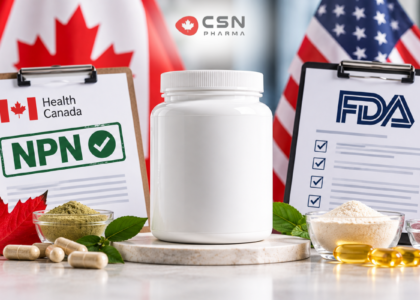
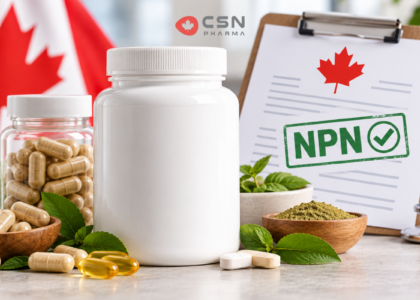
- Product Licensing (NPN): Every NHP sold in Canada must have a Product Licence. Once approved, Health Canada issues an 8-digit Natural Product Number (NPN), which must be clearly displayed on your product label. To get an NPN, an application must be submitted detailing the product’s medicinal ingredients, source, potency, and supported health claims. This approval process typically takes anywhere from 2 months to 1 year.
Get your NPN assessment today.
- Health Canada Site License: When choosing a manufacturing partner, one of the most important steps is verifying that the facility holds a valid Health Canada Site Licence and follows Good Manufacturing Practices (GMP).
While many facilities may offer manufacturing services, not all are properly licensed to produce natural health products in Canada. In some cases, it can also be difficult to confirm whether a facility is operating under a valid Site Licence.
- Health Canada’s labelling requirements are detailed and cover everything from mandatory bilingual text and font specifications to ingredient declarations, warnings, and product claims. Even minor errors can delay product launches or result in costly relabelling. You can review the official Health Canada labelling guidance here: https://www.canada.ca/en/health-canada/services/drugs-health-products/natural-non-prescription/legislation-guidelines/guidance-documents/labelling.html
Working with a private label supplement manufacturer helps you avoid much of this complexity. Since the formulations, regulatory documentation, and labelling framework are already established, you can significantly reduce compliance risks, accelerate your launch timeline, and focus on building your brand instead of navigating every regulatory requirement from scratch.
2. Choose the Right Private Label Supplement Manufacturer in Canada
Your manufacturer is your most vital strategic partner. When vetting prospective manufacturers for the Canadian market, use this operational checklist:
- Health Canada Compliance & GMP 4.0: Ensure they possess a valid Canadian Site Licence. Crucially, verify that their Standard Operating Procedures (SOPs) are fully updated to meet Health Canada’s strict GMP Guidance Version 4.0 standards, which serve as the sole reference standard for quality audits.
- Quality Documents: Along with the fundamental GMP certificates, it is important that the manufacturer you partner with also has quality certifications such as SQF, Organic, and Halal certificates.
- Existing Formula & Monograph Portfolios: Premium private label manufacturers already hold pre-approved formulations. Using these pre-approved formulations allows you to skip the regulatory approval-related wait times and launch your brand right away. Explore our private label product catalog here
- Minimum Order Quantities (MOQs): Startups should look for agile manufacturers offering flexible MOQs to test market demand without tying up excessive capital in heavy initial inventory.
- Testing and Certificate of Analysis (CoA): Ensure the manufacturer provides rigorous third-party testing reports confirming product purity, micro-testing limits, heavy metal thresholds, and exact ingredient potencies.
- Flexible Product and Formulation Options: Flexible Product and Formulation Options: When selecting a manufacturing partner for your private-label or white-label supplement brand, it is important to choose one that offers flexibility as your business grows. The right partner should allow you to start with an existing private-label formulation owned by the manufacturer, transition the product to your own brand by obtaining your own NPN, and eventually customize the formulation to create a product that is truly unique to your business.
3. Formulate Your Brand Strategy and Product Niche
The supplement space is highly competitive. Standing out requires an explicit focus on a target demographic rather than attempting to sell a generic “multivitamin for everyone.”
Identify high-growth market segments, such as:
- Cognitive Health & Nootropics: Focus, memory, and stress-mitigation formulas.
- Beauty from Within: Marine collagen peptides and hyaluronic acid for skin, hair, and nail health.
- Sleep & Relaxation: Non-melatonin sleep aids utilizing premium adaptogens like Ashwagandha or L-Theanine.
- Eco-Conscious Fitness & Sports Nutrition: Clean, organic, plant-based proteins, clean-ingredient electrolytes, and premium creatine powders.
Align your brand identity (minimalist, clinical, athletic, or eco-friendly) with the precise values of your chosen niche market.
4. Design Compliant Labels and Packaging
Health Canada enforces precise, uncompromising rules regarding supplement labels. A creative label design is useless if it gets flagged, recalled, and pulled from the market. Your product packaging must include:
| Required Element | Health Canada Specification |
| Bilingual Text | All mandatory label text (including warnings and directions) must be written in both English and French. |
| NPN Display | The 8-digit Natural Product Number must be prominently and legibly placed on the principal display panel. |
| Standardized Product Facts Table (PFT) | Heavy alignment with pharmaceutical “Plain Language Labelling” rules. Must clearly itemize medicinal ingredients, doses, and non-medicinal ingredients using approved sans-serif fonts, strict formatting, high contrast, and mandatory priority allergen disclosures. |
| Clear Claims | Any statement regarding health benefits must match the exact, verified wording approved under your NPN application or monograph alignment. |
| Safety Information | Must clearly list any relevant warnings, risk factors, allergy statements, and expiry dates. |
5. Set Up Your E-commerce and Logistics Framework
With a fully compliant product in hand, you need a friction-free infrastructure to sell and distribute it safely.
- Choose Your E-commerce Platform: Shopify remains the gold standard for supplement brands due to its robust ecosystem, localized Canadian tax tools, and seamless payment integrations. Ensure your payment gateway explicitly allows the sale of dietary supplements, as some third-party processors impose restrictive terms on health products.
- Fulfillment Options: You can either fulfill orders yourself or partner with a Third-Party Logistics (3PL) provider. If utilizing a 3PL in Canada, ensure their facilities follow climate-controlled, sanitary guidelines required to properly house natural health products.
- Note on Amazon FBA Canada: If you plan to sell on Amazon.ca, you will be required to submit your Health Canada NPN certificate and real-time photos of the physical product labels matching the Health Canada database before your listings can be approved to go live. At CSN Pharma, we support brands with all the required documents and shipping support that is required to send the products to Amazon CA and US.
6. Execute a Compliant Marketing Strategy
Marketing supplements in Canada requires careful phrasing. Because Health Canada regulates these products strictly, making unauthorized, sweeping medical claims like “cures anxiety” or “prevents chronic disease” will lead to immediate compliance penalties, forced product recalls, or blacklisting.
- Leverage Structure-Function Claims: Focus on how the product supports natural biological functions (e.g., “Helps maintain immune function” or “Source of antioxidants for the maintenance of good health” rather than “Fights off viruses”).
- Influencer Marketing: Partner with Canadian micro-influencers in the wellness and fitness niches. Ensure they disclose sponsored posts according to Ad Standards Canada guidelines.
- Content Marketing & SEO: Publish evidence-based articles citing peer-reviewed studies to build trust. Education-first marketing works incredibly well for consumers seeking long-term health solutions.
Final Thoughts
Launching a private label supplement brand in Canada is a challenging but immensely rewarding business venture, as it allows you to enter the market, validate customer demand, and scale much faster than developing a custom supplement from the ground up. By leveraging existing Health Canada-approved formulations and an experienced manufacturing partner, entrepreneurs can reduce development costs, shorten time-to-market, and build a compliant brand with significantly lower risk.
By partnering with a Canadian Site-Licensed manufacturer, selecting Health Canada-approved formulations, and implementing a clear brand strategy, you can confidently launch and grow a successful supplement brand in the Canadian marketplace. As your business expands, you can transition from private label products to your own licensed formulations, giving your brand complete ownership and long-term flexibility.
One of the biggest advantages of working with a private label supplement manufacturer is flexibility. New brands can launch quickly using existing Health Canada-approved formulations and later transition to their own licensed products as sales grow. This approach reduces upfront investment, minimizes regulatory delays, and provides a practical pathway for building a scalable supplement business in Canada.
Whether you’re launching your first supplement brand or expanding an existing product line, partnering with an experienced private label supplement manufacturer can help you reach the market faster while remaining fully compliant with Health Canada regulations.
Ready to launch your supplement brand? Contact CSN Pharma today to explore our private label product catalogue and receive expert guidance on selecting the right Health Canada-approved formulations for your business.
Related Articles
If you’re planning a focused product launch, explore these detailed guides:
- How to Launch a Private Label Creatine Product in 2026
- How to Launch a Private Label Electrolyte Product in 2026
These articles provide category-specific detailed insights into product development, market demand, branding, and launch strategies.