NPN vs. FDA: Understanding Supplement Regulations in Canada and the U.S.
(by CSN Pharma — Canadian Health Canada–licensed, GMP- and SQF-certified supplement manufacturer)
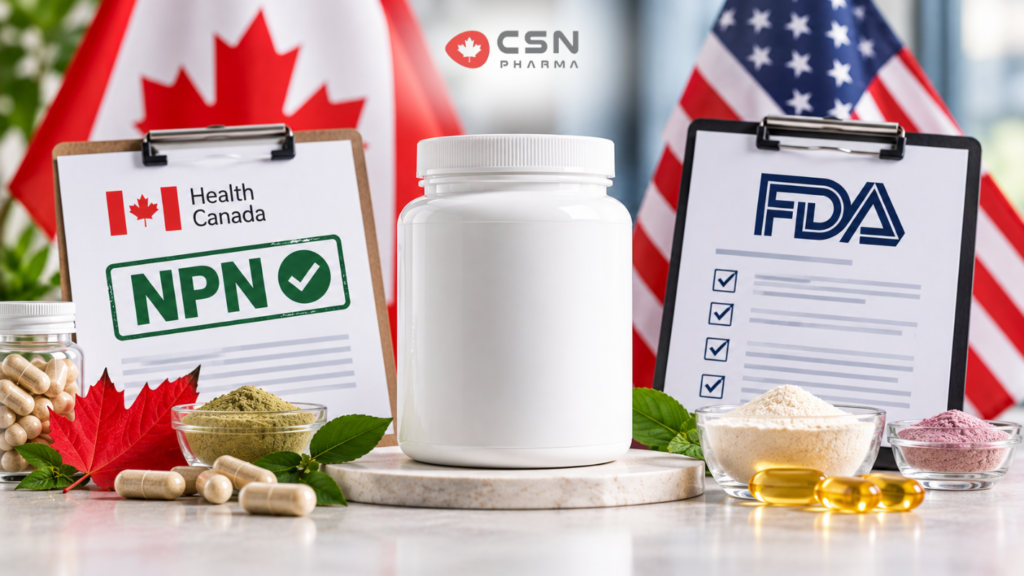
NPN vs. FDA: Understanding Supplement Regulations in Canada and the U.S.
Selling supplements in Canada vs. the US involves entirely different regulatory landscapes. Launching a successful brand across North America requires more than a great formula; it demands a deep understanding of cross-border compliance.
One of the most common hurdles for emerging brands is navigating NPN vs. FDA supplements frameworks. While both countries strictly enforce dietary supplement regulations to protect consumers, their core structures are opposites. Canada operates on a pre-market approval system requiring an NPN, whereas the U.S. FDA relies on post-market enforcement under DSHEA. Understanding these distinct rules early will save your brand from costly reformulation and relabeling delays.
NPN vs. FDA: The Key Difference
The simplest way to understand the difference is this:
Canada requires Natural Health Products (NHPs) to receive a product licence and NPN before they can generally be sold, while the U.S. does not generally require FDA pre-market approval of dietary supplements.
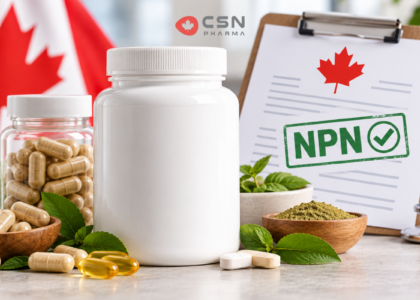
In Canada, Health Canada reviews an NHP application and, when the product meets the applicable requirements, issues an eight-digit Natural Product Number (NPN). The NPN must appear on the product label.
In the United States, dietary supplements are regulated primarily under the Dietary Supplement Health and Education Act (DSHEA). The FDA does not have authority to approve dietary supplements for safety and effectiveness before they are marketed. Instead, companies are responsible for ensuring that their products comply with applicable laws and regulations, while the FDA has significant post-market enforcement authority.
This means that an NPN is not simply the Canadian equivalent of “FDA approval.” The two systems operate differently.
What Is an NPN in Canada?
An NPN stands for Natural Product Number. It is an eight-digit product licence number issued by Health Canada for licensed natural health products.
Natural health products in Canada can include vitamins, minerals, herbal products, probiotics, traditional medicines, omega-3 products, and other products that fall within the NHP regulatory framework.
Before an NHP can generally be legally sold in Canada, the product must obtain a product licence. The application can include information such as:
- Medicinal ingredients
- Ingredient sources
- Potency
- Dosage
- Recommended use or purpose
- Non-medicinal ingredients
- Supporting evidence for safety and efficacy
- Product and labeling information
Once the product is assessed and authorized, the NPN is assigned to the product.
Brands can also use Health Canada’s Licensed Natural Health Products Database to verify licensed products and review information such as ingredients, dosage forms, recommended uses, and risk information.
For brands planning to sell in Canada, obtaining the appropriate product licence should therefore be part of the product development strategy—not an afterthought.
What Does the FDA Require for Supplements in the U.S.?
In the United States, dietary supplements are regulated as a category of products under the federal food and drug framework rather than being subject to the same pre-market approval system used for drugs.
The FDA does not generally approve dietary supplements or their labels before they reach consumers. Manufacturers and distributors are responsible for ensuring that their products are safe, properly labeled, and compliant with applicable requirements.
However, this does not mean that U.S. supplements are unregulated.
Companies must comply with applicable FDA requirements concerning areas such as:
- Product safety
- Dietary ingredients
- Labeling
- Supplement Facts information
- Manufacturing practices
- Adulteration and misbranding
- Certain new dietary ingredients
- Serious adverse event reporting
For example, dietary supplement labels must include a Supplement Facts panel containing information such as serving size, servings per container, dietary ingredients, and amounts per serving.
For certain products containing a new dietary ingredient, a notification to FDA may be required before marketing, subject to the applicable requirements and exemptions.
Canada vs. U.S.: Supplement Regulation Compared
Requirement | Canada | United States |
|---|---|---|
Regulatory authority | Health Canada / NNHPD | FDA |
Product category | Natural Health Product (NHP) | Dietary Supplement |
Pre-market product authorization | Generally required | Generally not required |
Product number | NPN issued for licensed NHPs | No equivalent universal product approval number |
Safety & efficacy review | Part of the NHP licensing process | Company is responsible for compliance; no general FDA pre-market approval |
Label requirements | Detailed NHP labeling requirements | Supplement Facts and other applicable labeling requirements |
Manufacturing requirements | GMP requirements and applicable site licensing | FDA dietary supplement CGMP requirements |
Claims | Must be supported and consistent with authorized conditions of use | Claims must comply with applicable FDA requirements and be appropriately substantiated |
Post-market oversight | Health Canada compliance and adverse reaction framework | FDA monitoring, inspections, recalls and enforcement |
The most important takeaway is that the same supplement formula cannot simply be treated as compliant in both markets because it meets the requirements of one country.
NPN vs. FDA: What Does This Mean for Supplement Brands?
Suppose a brand develops a vitamin, electrolyte powder, probiotic, or botanical supplement and wants to sell it in both Canada and the U.S.
The formula may need to be reviewed from two separate regulatory perspectives.
1. Ingredients May Need a Market-Specific Review
An ingredient that works within a Canadian NHP formulation may require a different regulatory assessment for the U.S. market.
The regulatory status of ingredients, dosage levels, claims, and intended use can affect how a product is treated in each country.
This is why brands expanding across North America should evaluate their formula before manufacturing large quantities.
Working with a manufacturer that understands both markets can help identify potential issues early.
2. Product Claims Can Be Different
Claims are another major area where Canadian and U.S. requirements can differ.
In Canada, the recommended use or health claim forms part of the product licensing process, and evidence supporting the proposed conditions of use may be required.
In the U.S., companies must ensure that claims comply with applicable FDA requirements. Dietary supplement claims cannot turn a supplement into an unapproved drug by claiming to diagnose, treat, cure, or prevent a disease.
Therefore, a marketing statement that appears acceptable for one market should not automatically be copied onto packaging for the other.
Your formula, claims, dosage, and labeling should be reviewed market by market.
3. Labeling Requirements Are Not the Same
Packaging is one of the most visible differences between the two markets.
Canadian NHP labels have specific requirements, including product information, medicinal and non-medicinal ingredients, recommended use, warnings, and the product licence number where applicable.
U.S. dietary supplements use a Supplement Facts panel and have their own labeling requirements under the FDA framework.
This means that a brand planning a North American launch should avoid assuming that one label design will automatically satisfy both markets.
Instead, develop the packaging with the regulatory requirements of each target market in mind.
4. Manufacturing Compliance Matters in Both Markets
Regulatory compliance does not stop at the product formula.
In Canada, businesses manufacturing, packaging, labeling, or importing NHPs for commercial sale generally require the appropriate site licence, and applicable Good Manufacturing Practices must be followed.
The U.S. also has dietary supplement Current Good Manufacturing Practice requirements designed to help ensure products meet specifications for identity, purity, strength, composition, and other applicable quality characteristics.
For a brand selling in both countries, selecting a manufacturing partner with experience across both regulatory environments can simplify the process.
Explore CSN Pharma’s Quality Assurance approach and learn how quality systems support compliant supplement manufacturing.
Can an NPN Be Used in the U.S.?
No. An NPN is a Canadian product licence number and does not replace U.S. regulatory requirements.
Likewise, meeting FDA requirements for a U.S. dietary supplement does not automatically provide authorization to sell the product as an NHP in Canada.
A brand entering both markets should treat Canada and the U.S. as two separate regulatory pathways.
This is especially important when planning: Formula development, Ingredient selection, Dosage levels, Health claims, Packaging, Labeling, Manufacturing documentation, Quality testing, Market launch.
How Private Label Brands Can Simplify Compliance
For new supplement brands, navigating regulatory requirements can become complicated quickly.
A private label or contract manufacturing partner with experience in the target market can help brands understand the practical requirements before production begins.
CSN Pharma’s private label supplement manufacturing services are designed for brands looking to develop and manufacture supplements for the North American market.
Brands can also explore CSN Pharma’s product development services when developing a new formula or adapting an existing concept.
For additional guidance, read How to Launch a Private Label/White Label Supplement Brand in Canada: A Step-by-Step Guide.
A Practical Checklist for Brands Selling in Canada and the U.S.
Before launching a supplement across both markets, consider the following:
- Confirm how the product is classified in each market.
- Review every ingredient for market-specific regulatory requirements.
- Check dosage levels and serving sizes.
- Define the claims you want to make before finalizing the formula.
- Determine whether Canadian NPN licensing is required.
- Review U.S. dietary supplement requirements.
- Develop market-specific labels where necessary.
- Select a manufacturing facility with appropriate quality systems.
- Maintain complete ingredient, testing, manufacturing, and quality documentation.
- Review packaging and claims before printing large quantities.
- Build regulatory review into your launch timeline.
Taking these steps early can help prevent expensive changes after production has already started.
Why Regulatory Planning Should Start Before Manufacturing
One of the most common mistakes new supplement brands make is treating regulatory compliance as something to address after the product has been formulated.
In reality, regulatory requirements can influence the product from the beginning.
Your target market can affect ingredient selection, dosage, claims, label design, documentation, and even the manufacturing process.
That is why regulatory planning should happen before finalizing the formula and packaging.
For brands considering private label manufacturing, CSN Pharma’s resources on selecting a supplement manufacturer and supplement manufacturing FAQs can help you evaluate the manufacturing side of your launch.
Final Thoughts: NPN vs. FDA
The difference between an NPN and FDA requirements comes down to the structure of the two regulatory systems.
Canada uses a pre-market licensing model for NHPs, where products generally need a Health Canada product licence and NPN before they can be legally sold.
The U.S. does not generally require FDA pre-market approval for dietary supplements, but manufacturers and marketers remain responsible for ensuring their products comply with applicable requirements, while FDA retains post-market enforcement authority.
For brands targeting both countries, the best approach is not to ask, “Does my product have an NPN or FDA approval?”
Instead, ask: “Does my product meet the regulatory requirements of every market where I plan to sell it?”
That mindset can help you build a more efficient product development process, reduce compliance risks, and create a stronger foundation for scaling your supplement brand across North America.
Official Regulatory Resources
- Health Canada – Natural Health Product Licensing
- Health Canada – Licensed Natural Health Products Database
- U.S. FDA – Dietary Supplements
- U.S. FDA – FDA 101: Dietary Supplements
Regulatory requirements can change and may vary depending on the product, ingredients, claims, intended use, and market. Brands should obtain appropriate regulatory advice for their specific products before launch.
Frequently Asked Questions
- What does NPN stand for in Canada? NPN stands for Natural Product Number. It is an eight-digit number associated with a licensed natural health product in Canada.
- Is an NPN required to sell supplements in Canada? Natural health products sold in Canada require a product licence, which is identified by an NPN for most NHPs.
- Where can I verify an NPN? You can search Health Canada’s Licensed Natural Health Products Database to verify licensed NHP information.
- Does every NHP have an NPN? Most licensed NHPs carry an NPN, while homeopathic medicines use a DIN-HM.
- Can a private label supplement use an existing NPN? The regulatory arrangement depends on the product, licence holder and applicable licensing requirements. Brands should confirm the specific NPN and licensing structure with their regulatory and manufacturing partner before launch.