Top 5 Supplement Packaging Trends in the NHP Industry for 2026
(by CSN Pharma — Canadian Health Canada–licensed, GMP- and SQF-certified supplement manufacturer)
Packaging has always played a vital role in protecting formulations. However, the leading supplement packaging trends for 2026 go far beyond basic protection. Today’s packaging must perfectly balance consumer convenience, e-commerce durability, and regulatory compliance.
For brands operating in North America, navigating NHP packaging in Canada adds an extra layer of complexity, requiring strict adherence to bilingual labeling and Health Canada formats. Simultaneously, the push for sustainable supplement packaging is forcing brands to re-evaluate their materials. As the market becomes more saturated, your packaging must communicate product value instantly while surviving the modern e-commerce supply chain.
1. Stick Packs and Single-Dose Packaging Are Going Mainstream
Convenience is one of the biggest forces shaping supplement packaging in 2026.
Consumers increasingly want products that fit into busy, mobile lifestyles. Instead of carrying a large bottle or measuring powder every day, single-dose packaging provides a simple alternative.
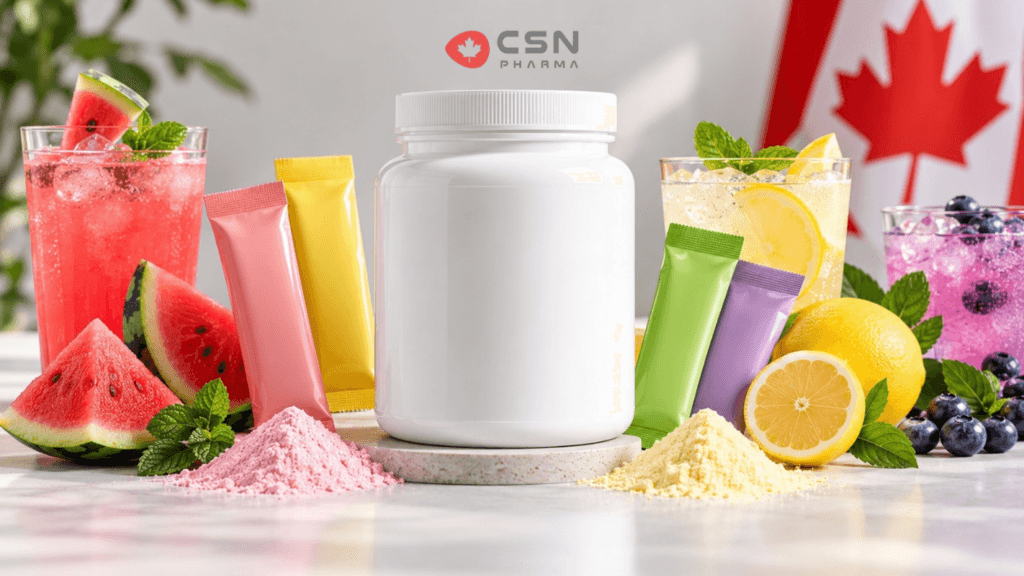
Stick packs and sachets are particularly relevant for: Electrolytes, Pre-workouts, Creatine, Greens powders, Collagen, Energy supplements, Vitamin powders, Functional drink mixes.
Recent industry research found that stick-pack launches in the vitamin, mineral, and supplement category increased by 34% between 2020 and 2024. Industry analysts also continue to identify stick packs and other portable formats as important areas of growth.
Why Are Stick Packs Becoming Popular?
The appeal is straightforward:
- Portable: Easy to carry in a gym bag, purse, backpack, or travel kit.
- Pre-measured: Each pack can contain a predetermined serving.
- Convenient: No need to carry a full container or measure individual servings.
- Brand-friendly: Individual packs provide additional surface area for branding and product communication.
- Suitable for e-commerce: Lightweight formats can be easier to ship and integrate into subscription models.
For electrolyte brands in particular, stick packs can make sense because the consumer can carry individual servings and mix them whenever needed.
CSN Pharma offers stick pack packaging for products including electrolytes, pre-workouts, and creatine.
What This Means for Brands
If your product is designed around portability or daily convenience, packaging should reinforce that positioning.
A premium electrolyte product, for example, may benefit more from individually packed servings than from a large bulk container alone.
The packaging format becomes part of the product experience.
2. Sustainable and Recyclable Packaging Is Becoming a Bigger Priority
Sustainability is no longer simply a branding statement.
Consumers increasingly pay attention to what a product is packaged in, while regulators are also introducing stricter requirements around packaging materials, recyclability, and environmental claims.
Research into consumer health packaging indicates that paper-based packaging can have a strong influence on purchasing decisions, particularly among consumers who associate it with more sustainable products. At the same time, advances in barrier technologies are creating new possibilities for paper-based formats that still need protection against moisture and oxygen.
What Are Brands Exploring?
Depending on the product and market, brands are evaluating: Recyclable packaging, Recycled-content materials, Paper-based packaging, Reduced packaging material, Lightweight bottles, Recyclable pouches, More efficient secondary packaging, Mono-material packaging solutions.
However, sustainability cannot be considered separately from product stability.
Supplements and NHPs may be sensitive to: Moisture, Oxygen, Light, Temperature, Humidity.
A packaging material may look environmentally attractive but still be unsuitable if it does not provide the necessary barrier protection.
Sustainability Meets Regulation
Packaging sustainability is also becoming a regulatory issue.
In European markets, new packaging rules are introducing requirements around recyclability, recycled content, PFAS, and environmental claims. The supplement industry has been closely monitoring these changes because flexible packaging and other commonly used formats can be affected.
For brands selling internationally, packaging decisions therefore need to consider not only consumer expectations but also the regulatory requirements of each market.
3. E-Commerce-Ready Packaging Is Becoming Essential
Supplement packaging used to be designed primarily around the retail shelf. Today, many products reach consumers through online stores, marketplaces, subscriptions, and direct-to-consumer websites.
That changes what packaging needs to do.
In a physical store, packaging needs to: Stand out on the shelf, Communicate key benefits quickly, Create visual differentiation.
In e-commerce, the priorities are somewhat different. Packaging needs to: Protect the product during transportation, Resist crushing and damage, Prevent leakage or contamination, Arrive looking professional, Provide clear product information, Minimize unnecessary shipping volume.
This is particularly important for supplement brands that ship directly to consumers. Industry packaging research recommends considering transit testing for e-commerce packaging because products can experience multiple handling and distribution conditions before reaching the customer.
Packaging Is Part of the Unboxing Experience
E-commerce also creates another opportunity: the unboxing experience.
The customer may never see your product on a physical shelf. Their first physical interaction with your brand could happen when they open the shipping box.
That means: Product packaging = protection + information + brand experience.
A clean, professional package can reinforce the perception of product quality and trust.
4. Clean, Minimal Packaging With Greater Transparency
Supplement consumers are becoming more informed.
They are increasingly researching ingredients, formulations, certifications, sourcing, and manufacturing practices before purchasing a product.
A 2026 consumer trend report from The Vitamin Shoppe found that transparency is an important purchase factor, with consumers placing greater emphasis on ingredient disclosure, certifications, sourcing, and manufacturing information.
Packaging needs to respond to this behaviour.
What Does Transparent Packaging Communication Look Like?
Instead of overwhelming consumers with dozens of marketing claims, brands are increasingly moving toward clearer information hierarchies.
A well-designed supplement package should make it easy to identify: Product name, Product category, Key ingredients, Serving size, Quantity, Directions, Warnings, Certifications where applicable, Regulatory information, Company information.
This does not mean packaging has to look boring. Minimal packaging can still be distinctive through: Strong typography, Strategic use of colour, Clear information hierarchy, Premium finishes, Simple graphics, Consistent brand architecture.
The goal is to make the product easier to understand while building credibility.
NHP Packaging Requires Extra Attention
For brands selling Natural Health Products in Canada, packaging is not only a branding exercise.
Health Canada requirements apply to NHP labels, including elements such as the NPN, bilingual mandatory information, product facts, warnings, directions, and approved claims.
Brands can refer to the official Health Canada NHP labelling guidance when reviewing Canadian NHP packaging requirements.
This is why packaging development should ideally happen alongside regulatory and product development rather than at the very end of the launch process.
CSN Pharma’s supplement product development services integrate formulation, product development, and co-packing considerations into the development process.
5. Flexible Packaging and Multiple Formats Are Expanding
One packaging format no longer needs to work for every consumer.
Supplement brands are increasingly building product portfolios around different consumption occasions.
- At Home: Bottle or pouch. Suitable for consumers who use the product regularly at home.
- At the Gym: Stick pack or sachet. Convenient for pre-workout, creatine, or electrolyte products.
- While Travelling: Single-dose format. Easy to pack and use without carrying the full product container.
- On the Go: Ready-to-drink or single-serving formats. Designed around maximum convenience.
This move toward multiple formats reflects a wider change in supplement consumption. Industry coverage in 2026 highlights continued growth and innovation across stick packs, sachets, shots, gummies, chewables, RTDs, and other convenient formats.
Bottle vs Pouch vs Stick Pack: Which Format Is Right for Your Supplement?
Packaging Format | Best Suited For | Key Advantage |
|---|---|---|
Bottle | Capsules, tablets, powders | Familiar and versatile |
Pouch | Powders and bulk products | Lightweight and flexible |
Stick Pack | Electrolytes, creatine, pre-workouts | Portable and single-dose |
Sachet | Single servings and samples | Convenient and compact |
CSN Pharma provides bottle, pouch, and stick-pack packaging solutions for supplement brands, allowing packaging to be selected based on the product and intended market.
How Should Supplement Brands Choose Packaging in 2026?
Before selecting a packaging format, brands should evaluate more than appearance. Consider these questions:
- What is the product? Powders, capsules, gummies, liquids, and tablets have different packaging requirements.
- Who is the consumer? A product designed for athletes may benefit from portable stick packs, while a daily capsule supplement may be better suited to a bottle.
- Where will it be sold? Retail, e-commerce, subscription, and international markets can all create different packaging requirements.
- What does the formulation require? Consider moisture, oxygen, light, and other stability requirements before choosing a material.
- What are the regulatory requirements? Packaging must accommodate mandatory information and market-specific requirements.
- What is the brand positioning? Premium, clinical, natural, sports, lifestyle, and mass-market brands may all require different packaging strategies.
- Can the format scale? Packaging should work not only for the first order but also as the brand grows.
The Future of Supplement Packaging
Supplement packaging is moving from a simple protective function toward a much more strategic role.
The winning packaging strategies of the future will likely combine: Convenience through portable formats, Sustainability through smarter material choices, Protection through appropriate barrier properties, Transparency through clear product information, E-commerce readiness through durable shipping-friendly designs, Differentiation through strong visual identity, Flexibility through multiple formats and serving options.
The key is balance. A package can be visually appealing, but if it does not protect the formulation, it is not effective.
Final Thoughts
In 2026, supplement and NHP packaging is becoming an increasingly important part of product strategy.
Consumers want convenience. Brands want differentiation. Regulators are placing greater emphasis on packaging requirements and sustainability. E-commerce is changing how products need to survive distribution.
Together, these factors are pushing the industry toward smarter packaging choices. For supplement brands, the goal should not simply be to choose the packaging that looks best. It should be to choose the format that protects the product, fits the consumer’s lifestyle, communicates the brand clearly, meets market requirements, and supports scalable growth.
Planning Your Next Supplement Product?
CSN Pharma provides supplement product development, manufacturing, and packaging solutions for brands developing and scaling natural health products.
From bottle packaging to pouches and stick packs, the right packaging format can be selected based on your product, market, and business requirements.
Contact CSN Pharma to discuss your next supplement or NHP project.